• About Us
    • Mission Statement
    • Forms
      • Donation Letters
      • LHHV Legal Page
      • Support Letters
    • LHHV Documentation
      • Mission Statement
      • Executive Summary 2010
      • LHHV By-Laws
      • LHHV Code of Ethnics
      • LHHV Policies and Procedures
      • Maps
      • Executive Summary Pitt
      • LHHV Employee Handbook
  • Veterans Projects
    • Feeding Our Veterans in Need
    • Veteran’s Memorial Tags & Benches
    • Laurel Highlands Veterans Forms
  • Contact LHHV
  • ARTS & HERITAGE FESTIVAL 2026
    • Sponsorship Support Letter
    • Event Brochure and map for 2025
    • Vendor & Crafter Application 2025
    • Festival Map
  • Laurel Highlands Exploration Center
    • Historical Element
      • Luna Park Roxbury Gone
      • Mount Davis Mountain
      • Ohiopyle Region
      • Mt. Davis
      • Laurel Highlands Unexplained Activity
      • Lemon House and Portage Railroad
      • Laurel Highlands Unexplained Activity
      • Johnstown National Flood Park
      • Folklore, Myths and Legends
      • Fort Ligonier
      • Idlewild Park and Soak Zone
      • Laurel Caverns
      • Johnstown Floods 1889 and 1936
      • Hiking Trails in Central PA
      • Walking Tour of Johnstown
      • A Trail Full of History
      • Caves and Caverns
      • Horseshoe Curve
      • Ebensburg County Seat
      • Buttermilk Falls
      • LHHV at Gettysburg
      • Bethlehem Steel
      • Folklore & Legends
      • Fort Ligonier
      • Blue Knob State Park & Ski Resort
      • Boy Scouts of America – Penn’s Woods Counsel
      • Gettysburg
    • Recreational Activities
      • Laurel Highlands Veterans Greenway Lop Trail
      • LHHV Forest Trails Hiking Rules
      • Honan Ave Hiking Trail
      • Weather in the Laurel Highlands
      • Trails
      • Local Attractions
      • Johnstown Attractions
      • Boating Rafting Kayaking
      • Winter Fun
      • LHHV Forest Trails Hiking Rules
    • Education
      • Conservation & Wildlife
      • Backyard Astronomy
      • Ethnic Music
        • Duquesne University Tamburitzans
      • Ethnic Communities
        • Caribbean Countries
        • European Counties
        • English
        • East Asia and Oceania
        • Central America
        • Asia
        • Africa
      • Ethnic Recipes
        • Apple Press Homemade
    • Wellness Support
      • Veterans Administration
      • Veterans Leadership Program
      • How to build a Wellness Park
      • Serenity Gardens their mission
    • Community Engagement
  • Videos
  • Various LHHV Pictures
  • Johnstown History Jim Gindlesperger
  • LHHV LOGOS
  • Laurel Highlands Wildlife
  • Laurel Highlands in Pictures

Laurel Highlands Historical Village

Be Proud of Who You Are - Be Proud of Your Heritage

  • Laurel Highlands Historical Village
  • About Us
    • Mission Statement
    • Forms
      • Donation Letters
      • LHHV Legal Page
      • Support Letters
    • LHHV Documentation
      • Mission Statement
      • Executive Summary 2010
      • LHHV By-Laws
      • LHHV Code of Ethnics
      • LHHV Policies and Procedures
      • Maps
      • Executive Summary Pitt
      • LHHV Employee Handbook
  • Veterans Projects
    • Feeding Our Veterans in Need
    • Veteran’s Memorial Tags & Benches
    • Laurel Highlands Veterans Forms
  • Contact LHHV
  • ARTS & HERITAGE FESTIVAL 2026
    • Sponsorship Support Letter
    • Event Brochure and map for 2025
    • Vendor & Crafter Application 2025
    • Festival Map
  • Laurel Highlands Exploration Center
    • Historical Element
      • Luna Park Roxbury Gone
      • Mount Davis Mountain
      • Ohiopyle Region
      • Mt. Davis
      • Laurel Highlands Unexplained Activity
      • Lemon House and Portage Railroad
      • Laurel Highlands Unexplained Activity
      • Johnstown National Flood Park
      • Folklore, Myths and Legends
      • Fort Ligonier
      • Idlewild Park and Soak Zone
      • Laurel Caverns
      • Johnstown Floods 1889 and 1936
      • Hiking Trails in Central PA
      • Walking Tour of Johnstown
      • A Trail Full of History
      • Caves and Caverns
      • Horseshoe Curve
      • Ebensburg County Seat
      • Buttermilk Falls
      • LHHV at Gettysburg
      • Bethlehem Steel
      • Folklore & Legends
      • Fort Ligonier
      • Blue Knob State Park & Ski Resort
      • Boy Scouts of America – Penn’s Woods Counsel
      • Gettysburg
    • Recreational Activities
      • Laurel Highlands Veterans Greenway Lop Trail
      • LHHV Forest Trails Hiking Rules
      • Honan Ave Hiking Trail
      • Weather in the Laurel Highlands
      • Trails
      • Local Attractions
      • Johnstown Attractions
      • Boating Rafting Kayaking
      • Winter Fun
      • LHHV Forest Trails Hiking Rules
    • Education
      • Conservation & Wildlife
      • Backyard Astronomy
      • Ethnic Music
        • Duquesne University Tamburitzans
      • Ethnic Communities
        • Caribbean Countries
        • European Counties
        • English
        • East Asia and Oceania
        • Central America
        • Asia
        • Africa
      • Ethnic Recipes
        • Apple Press Homemade
    • Wellness Support
      • Veterans Administration
      • Veterans Leadership Program
      • How to build a Wellness Park
      • Serenity Gardens their mission
    • Community Engagement
  • Videos
  • Various LHHV Pictures
  • Johnstown History Jim Gindlesperger
  • LHHV LOGOS
  • Laurel Highlands Wildlife
  • Laurel Highlands in Pictures

LHHV at Gettysburg

Gettysburg

The Battle of Gettysburg was fought July 1–3, 1863, in and around the town of Gettysburg, Pennsylvania, by Union and Confederate forces during the American Civil War. The battle involved the largest number of casualties of the entire war and is often described as the war’s turning point.[12][13] Union Maj. Gen. George Meade‘s Army of the Potomac defeated attacks by Confederate Gen. Robert E. Lee‘s Army of Northern Virginia, halting Lee’s invasion of the North.

After his success at Chancellorsville in Virginia in May 1863, Lee led his army through the Shenandoah Valley to begin his second invasion of the North—the Gettysburg Campaign. With his army in high spirits, Lee intended to shift the focus of the summer campaign from war-ravaged northern Virginia and hoped to influence Northern politicians to give up their prosecution of the war by penetrating as far as Harrisburg, Pennsylvania, or even Philadelphia. Prodded by President Abraham Lincoln, Maj. Gen. Joseph Hooker moved his army in pursuit, but was relieved of command just three days before the battle and replaced by Meade.

Elements of the two armies initially collided at Gettysburg on July 1, 1863, as Lee urgently concentrated his forces there, his objective being to engage the Union army and destroy it. Low ridges to the northwest of town were defended initially by a Union cavalry division under Brig. Gen. John Buford, and soon reinforced with two corps of Union infantry. However, two large Confederate corps assaulted them from the northwest and north, collapsing the hastily developed Union lines, sending the defenders retreating through the streets of the town to the hills just to the south.[14]

On the second day of battle, most of both armies had assembled. The Union line was laid out in a defensive formation resembling a fishhook. In the late afternoon of July 2, Lee launched a heavy assault on the Union left flank, and fierce fighting raged at Little Round Top, the Wheatfield, Devil’s Den, and the Peach Orchard. On the Union right, Confederate demonstrations escalated into full-scale assaults on Culp’s Hill and Cemetery Hill. All across the battlefield, despite significant losses, the Union defenders held their lines.

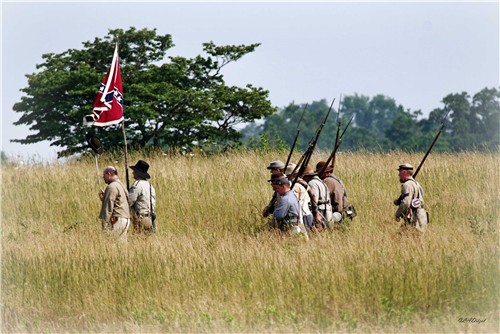
On the third day of battle, fighting resumed on Culp’s Hill, and cavalry battles raged to the east and south, but the main event was a dramatic infantry assault by 12,500 Confederates against the center of the Union line on Cemetery Ridge, known as Pickett’s Charge. The charge was repulsed by Union rifle and artillery fire, at great loss to the Confederate army.[15]

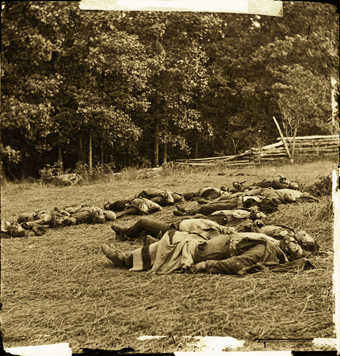
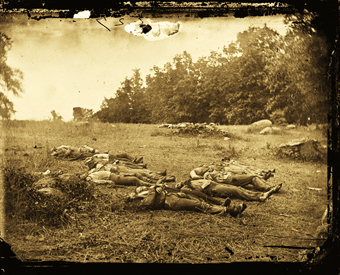
Lee led his army on a torturous retreat back to Virginia. Between 46,000 and 51,000 soldiers from both armies were casualties in the three-day battle, the most costly in US history.

On November 19, President Lincoln used the dedication ceremony for the Gettysburg National Cemetery to honor the fallen Union soldiers and redefine the purpose of the war in his historic Gettysburg Add

Background

Military situation

Main articles: Gettysburg Campaign and Gettysburg Battlefield
Further information: Battle of Chancellorsville, Eastern Theater of the American Civil War, and American Civil War


Gettysburg Campaign (through July 3); cavalry movements shown with dashed lines

  Confederate
  Union


This 1863 oval-shaped map depicts Gettysburg Battlefield during July 1–3, 1863, showing troop and artillery positions and movements, relief hachures, drainage, roads, railroads, and houses with the names of residents at the time of the Battle of Gettysburg.


A Harper’s Weekly illustration showing Confederate troops escorting captured African American civilians south into slavery. En route to Gettysburg, the Army of Northern Virginia kidnapped approximately 40 black civilians and sent them south into slavery.[16][17][18]

Shortly after the Army of Northern Virginia won a major victory over the Army of the Potomac at the Battle of Chancellorsville (April 30 – May 6, 1863), Robert E. Lee decided upon a second invasion of the North (the first was the unsuccessful Maryland Campaign of September 1862, which ended in the bloody Battle of Antietam). Such a move would upset U.S. plans for the summer campaigning season and possibly reduce the pressure on the besieged Confederate garrison at Vicksburg. The invasion would allow the Confederates to live off the bounty of the rich Northern farms while giving war-ravaged Virginia a much-needed rest. In addition, Lee’s 72,000-man army[6] could threaten Philadelphia, Baltimore, and Washington, and possibly strengthen the growing peace movement in the North.[19]

Initial movements to battle

Thus, on June 3, Lee’s army began to shift northward from Fredericksburg, Virginia. Following the death of Thomas J. “Stonewall” Jackson, Lee reorganized his two large corps into three new corps, commanded by Lt. Gen. James Longstreet (First Corps), Lt. Gen. Richard S. Ewell (Second), and Lt. Gen. A.P. Hill (Third); both Ewell and Hill, who had formerly reported to Jackson as division commanders, were new to this level of responsibility. The Cavalry Division remained under the command of Maj. Gen. J.E.B. Stuart.[20]

The Union Army of the Potomac, under Maj. Gen. Joseph Hooker, consisted of seven infantry corps, a cavalry corps, and an Artillery Reserve, for a combined strength of more than 100,000 men.[5]

The first major action of the campaign took place on June 9 between cavalry forces at Brandy Station, near Culpeper, Virginia. The 9,500 Confederate cavalrymen under Stuart were surprised by Maj. Gen. Alfred Pleasonton‘s combined arms force of two cavalry divisions (8,000 troopers) and 3,000 infantry, but Stuart eventually repulsed the Union attack. The inconclusive battle, the largest predominantly cavalry engagement of the war, proved for the first time that the Union horse soldier was equal to his Southern counterpart.[21]

By mid-June, the Army of Northern Virginia was poised to cross the Potomac River and enter Maryland. After defeating the Union garrisons at Winchester and Martinsburg, Ewell’s Second Corps began crossing the river on June 15. Hill’s and Longstreet’s corps followed on June 24 and 25. Hooker’s army pursued, keeping between the U.S. capital and Lee’s army. The Union army crossed the Potomac from June 25 to 27.[22]

Lee gave strict orders for his army to minimize any negative impacts on the civilian population.[23] Food, horses, and other supplies were generally not seized outright, although quartermasters reimbursing Northern farmers and merchants with Confederate money were not well received. Various towns, most notably York, Pennsylvania, were required to pay indemnities in lieu of supplies, under threat of destruction. During the invasion, the Confederates seized some 40 northern African Americans. A few of them were escaped fugitive slaves, but most were freemen; all were sent south into slavery under guard.[16][17][18]

On June 26, elements of Maj. Gen. Jubal Early‘s division of Ewell’s Corps occupied the town of Gettysburg after chasing off newly raised Pennsylvania militia in a series of minor skirmishes. Early laid the borough under tribute, but did not collect any significant supplies. Soldiers burned several railroad cars and a covered bridge, and destroyed nearby rails and telegraph lines. The following morning, Early departed for adjacent York County.[24]

Meanwhile, in a controversial move, Lee allowed J.E.B. Stuart to take a portion of the army’s cavalry and ride around the east flank of the Union army. Lee’s orders gave Stuart much latitude, and both generals share the blame for the long absence of Stuart’s cavalry, as well as for the failure to assign a more active role to the cavalry left with the army. Stuart and his three best brigades were absent from the army during the crucial phase of the approach to Gettysburg and the first two days of battle. By June 29, Lee’s army was strung out in an arc from Chambersburg (28 miles (45 km) northwest of Gettysburg) to Carlisle (30 miles (48 km) north of Gettysburg) to near Harrisburg and Wrightsville on the Susquehanna River.[25]

In a dispute over the use of the forces defending the Harpers Ferry garrison, Hooker offered his resignation, and Abraham Lincoln and General-in-Chief Henry W. Halleck, who were looking for an excuse to rid themselves of him, immediately accepted. They replaced Hooker early on the morning of June 28 with Maj. Gen. George Gordon Meade, then commander of the V Corps.[26]

On June 29, when Lee learned that the Army of the Potomac had crossed the Potomac River, he ordered a concentration of his forces around Cashtown, located at the eastern base of South Mountain and eight miles (13 km) west of Gettysburg.[27] On June 30, while part of Hill’s Corps was in Cashtown, one of Hill’s brigades, North Carolinians under Brig. Gen. J. Johnston Pettigrew, ventured toward Gettysburg. In his memoirs, Maj. Gen. Henry Heth, Pettigrew’s division commander, claimed that he sent Pettigrew to search for supplies in town—especially shoes.[28]

When Pettigrew’s troops approached Gettysburg on June 30, they noticed Union cavalry under Brig. Gen. John Buford arriving south of town, and Pettigrew returned to Cashtown without engaging them. When Pettigrew told Hill and Heth what he had seen, neither general believed that there was a substantial Union force in or near the town, suspecting that it had been only Pennsylvania militia. Despite General Lee’s order to avoid a general engagement until his entire army was concentrated, Hill decided to mount a significant reconnaissance in force the following morning to determine the size and strength of the enemy force in his front. Around 5 a.m. on Wednesday, July 1, two brigades of Heth’s division advanced to Gettysburg.[29]

Opposing forces

Union

Key commanders (Army of the Potomac)
  • Maj. Gen.
    George Meade, (Commanding) USA
  • Maj. Gen.
    John F. Reynolds, USA
  • Maj. Gen.
    Winfield Scott Hancock, USA
  • Maj. Gen.
    Daniel Sickles, USA
  • Maj. Gen.
    George Sykes, USA
  • Maj. Gen.
    John Sedgwick, USA
  • Maj. Gen.
    Oliver Otis Howard, USA
  • Maj. Gen.
    Henry Warner Slocum, USA
  • Maj. Gen.
    Alfred Pleasonton, USA

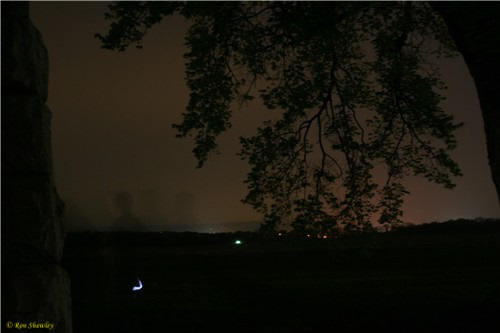
    Gettysburg Image NO Hoax – Picture taken by Photojournalist Ron Shawley

    The Gettysburg National Park closes around 10 am or so. Ron Shawley working on a story for the national park was just about to leave the park for the night at about 9: 45 pm. Ron had stopped at the High Water Mark when he noticed Blue Fog” a common occurrence that many visitors see.  Ron had his canon handy and decided to shot this oddity. Ron walked out to the edge of the High Water Mark, knowing all to well what played out here during the civil war. See  notes below… For the record Ron used the following settings to shoot the Blue Fog. ISo 800 exp 30 sec aperture wide open – Ron during the process of taking about 20 pictures felt a cool air mass hitting him. This was no big deal the evening air was simply cooling down, and the air currents were just moving around. After getting back to his hotel he decided to view the pictures. The 1st picture, the 2nd picture, the 3rd and so on, until he hit the 12th picture he noticed something odd, what looked like a double exposure. How could this be the camera does not work this way. So he blew up the picture and was shocked at what he saw. The raw picture below, look close and see what you see. Note he was alone, there was no one at all in the area when picture was taken. You can see the blue green fog in distance, and up close what looks like a minister praying with the troops.  The picture has been seen well over 1 million times, with some folks seeing one to as many as 12 images.  

    Great Ghosts of Gettysburg

    Between the first and the third of July, 1863, more blood was shed in a formerly little-known Adams County farm community than at any battle in history. The deaths on the battlefield at Gettysburg numbered 7,500, and probably a tenth of the wounded died later. With around ten thousand men down in a few horrific days, it’s hardly surprising Gettysburg has its fair share of ghost stories. But oddly enough, one of the stories comes to us from the time of the battle itself.

    Although the Confederates were ultimately devastated on July 3rd, 1863, the Union soldiers were actually in trouble at one point. The 20th Maine Division had arrived to reinforce the flagging troops, but they had no idea where to go. The division told the story that a striking figure in an old-fashioned uniform appeared on a white horse and led them up to Little Round Top, a strategic

    point that enabled them to rout a flank of Confederates and ultimately win the battle. The soldiers insisted that the glowing apparition they followed bore an uncanny resemblance to George Washington. There’s no denying this story reeks of propaganda—it’s only one step away from the old claim that “God is on our side”—but the story has had remarkably long life nevertheless.

    If you visit the National Military Park on a clear summer night, you will sometimes see fog creeping in and surrounding the field where so many people fell. Fog is always brings a creepy sensation with it, but such sudden ground mists are not exactly unusual weather for this kind of topology. But what’s inside the fog is a little more unusual. Lights flash on and off, appearing to advance along the same path that the Confederates took to Little Round Top. Sometimes, shadows or transparent apparitions appear on horseback. Although it’s hard to see anything in those conditions, these riders are often reported as being headless—though this may be due to an overactive imagination fired by too many readings of Sleepy Hollow.

    When you visit the huge boulders of the Devil’s Den, you may get helpful advice for framing the perfect photograph from a shabby looking youth sitting around in a big floppy hat. He’ll drawl from his perch that a certain pile of rocks would make a great photograph—but once you’ve snapped the scene, he’ll have disappeared. Folks call him the Helpful Hippy of the Devil’s Den.

    But far and away the most common ghostly phenomena at Gettysburg concern cameras. There were many photographs taken during the battle, but it seems nowadays that an unusual number of cameras malfunction on the field. Visitors often experience a chill when this happens—maybe because of the weather, maybe from a sudden supernatural fear, or perhaps from the presence of something not of this world.

    Spectral Sounds and Smells at the Farnsworth House, Gettsyburg

    The Farnsworth House Inn on Baltimore St, Gettysburg, was 53 years old when it was riddled with bullets from the famous Civil War battle that takes its name from the town. It displays the hundred bullet holes from that battle proudly, and its staff is well versed in lore and legend of the era. The staff also has a spirited way of promoting the place as one of the top ten most haunted inns in America. Whether it’s the Mourning Theatre, the candlelit ghost tours, or the ghostly dinner theater presentation, the hostelry has a knack for turning occult happenings into palatable entertainment.
    But it’s not all fun and games at the Farnsworth

    House Inn. One of the rooms, the Garrett, is closed and padlocked because things used to get too hairy there. The lock on that door sometimes rattles of its own accord, and meanwhile, up in the garret’s ensuite bathroom, a bloody mess that’s almost impossible to clean sometimes appears. The room was apparently a post for three Confederate sharpshooters during the conflict, and presumably at least one of them was seriously injured or killed there. In another upstairs room, a bereaved man is heard sobbing inconsolably, and seen carrying a child wrapped in a quilt. The door to the cellar often opens to an apparition carrying a wounded comrade down to the catacombs, where a voice is heard singing quietly. And in true Sixth Sense mode, the temperature suddenly plummets inexplicably.

    Other rooms feature less frightening occurrences. The McFarland Room often contains strange sounds, including unusually heavy breathing (and close-up, not from neighboring rooms). The Schultz Room is supposedly often visited by a solicitous midwife who tucks you in, and a little boy. Both are considered very benign presences, but apparently one of them smokes cigars. The smell of particularly acrid cheroot often pervades the room in the wee hours of the night.

    With all the media attention paid to the Farnsworth House, it’s amazing they can fit any paying guests into the place. Carol Kirkpatrick the psychic, Ghost Hunters International, the Sci-Fi Channel, Unsolved Mysteries, and The History Channel have all visited and reported on the place. None of them reported getting tucked in for the night, but one can only assume that they just attracted a different ghost.

    A Brush with a Farnsworth Ghost

    It’s hard to get into the haunted part of the Inn, but we lucked out last summer…kind of. When we went to bed, the covers and pillows were wrinkled, though we’d locked the door on a sharply-made hospital-corner bed only a couple of hours before. The bed moved during the night, as if someone sat down on it and got up again. The damn thing creaked even when we weren’t moving. I was glad when my husband began stroking my hair—it comforted me to know that he knew how much it was freaking me out. The trouble is, when I told him the next day how it had calmed me down a lot, he looked baffled. “I was asleep all night,” he told me, “I didn’t stroke your hair.” –Maggiruth

    The Kids Thought it was Funny

    I don’t think I’ll be staying at the Farnsworth House Inn again. They say that there are good spirits and bad spirits there, but something about the loud sounds of children laughing wigged me out completely. I should point out that there were no children staying in the inn at the time, and it went on too long to be something on TV. –S. Gallagher

    Chased by Ghosts from Gettysburg Cemetery

     I am a huge Civil War buff, so I travel to Gettysburg a lot.  I always stay in the same hotel downhill from the Gettysburg National Cemetery. Last October I went there with a friend of mine. Around ten at night on our second night there, I decided that I’d take a trip to the cemetery.  I climbed up the muddy hillside and got about 500 feet into the cemetery when I heard this weird chiming noise. I looked around for its source, and about 150 feet to my left was this pulsing, shimmering blue ball of light. It started floating towards me about four feet off of the ground. I got to the hill and slipped all the way down it on my butt. I heard that noise again, this time really close. I picked myself up and made my way running to the hotel room. I was pounding on the door. My buddy Dave opened the door and I pushed my way past him into the hotel room. I’ll still go back to Gettysburg but I won’t stay in that hotel or go back to that cemetery again. –Lucas Reeves

    The high-water mark of the Confederacy refers to an area on Cemetery Ridge near Gettysburg, Pennsylvania, marking the farthest point reached by Confederate forces during Pickett’s Charge on July 3, 1863.[1] Similar to a high water mark of water, the term is a reference to arguably the Confederate Army’s best chance of achieving victory in the war. The line of advance was east of “The Angle” stone wall[2] at various distances, e.g., the Virginians pushed the Union line back

     
    The 72nd Pennsylvania Infantry Monument marks their “advance position”.

    This designation was invented by government historian John B. Bachelder after the war when the monuments of the Gettysburg Battlefield were being erected.[3] Some historians have argued that the battle was the turning point of the war and that this was the place that represented the Confederacy’s last major offensive operation in the Eastern Theater.

    On the third day of the battle (July 3, 1863), Confederate General Robert E. Lee ordered an attack on the Union center, located on Cemetery Ridge. This offensive maneuver called for almost 12,500 men to march over 1,000 yards (900 m) of dangerously open terrain.

    Preceded by a massive but mostly ineffective Confederate artillery barrage, the march across open fields toward the Union lines became known as Pickett’s Charge; Maj. Gen. George E. Pickett was one of three division commanders under the command of Lt. Gen. James Longstreet, but his name has been popularly associated with the assault. Union guns and infantry on Cemetery Ridge opened fire on the advancing men, inflicting a 50% casualty rate on the Confederate ranks. One of Pickett’s brigade commanders was General Lewis Addison Armistead. His men were able to breach the Union lines in just one place, a bend in the wall that has become known as “the Angle.” This gap in the Union line was hastily closed with any Confederate soldiers who had breached it being quickly captured or killed, including Armistead.

    Lee’s Army of Northern Virginia retreated the next day, leaving Gettysburg for Virginia. Even though the war lasted almost another two years, Lee launched few offensive operations during that time, none of them near the scale of the Gettysburg Campaign.

    The photographic history of the Civil War - thousands of scenes photographed 1861-65, with text by many special authorities (1911) (14576212479).jpgThe photographic history of the Civil War - thousands of scenes photographed 1861-65, with text by many special authorities (1911) (14576398397).jpg
    Panorama of the High-Water Mark from The Photographic History of the Civil War: In the center of the panorama rises Cemetery Ridge, where the defeated 1st and 11th Federal Corps slept on their arms on the night of July 1st, after having been driven back through the town by the superior forces of Hill and Ewell. The lower eminence to the right of it is Culp’s Hill. At the extreme right of the picture stands Round Top.


    High-Water Mark 9:50 PM

  • About Us
  • Veterans Projects
  • Contact LHHV
  • ARTS & HERITAGE FESTIVAL 2026
  • Laurel Highlands Exploration Center

Handcrafted with on the Genesis Framework